
Corporate Laws (Amendment) Bill, 2026: Major Recommendations and What Businesses Need to Know
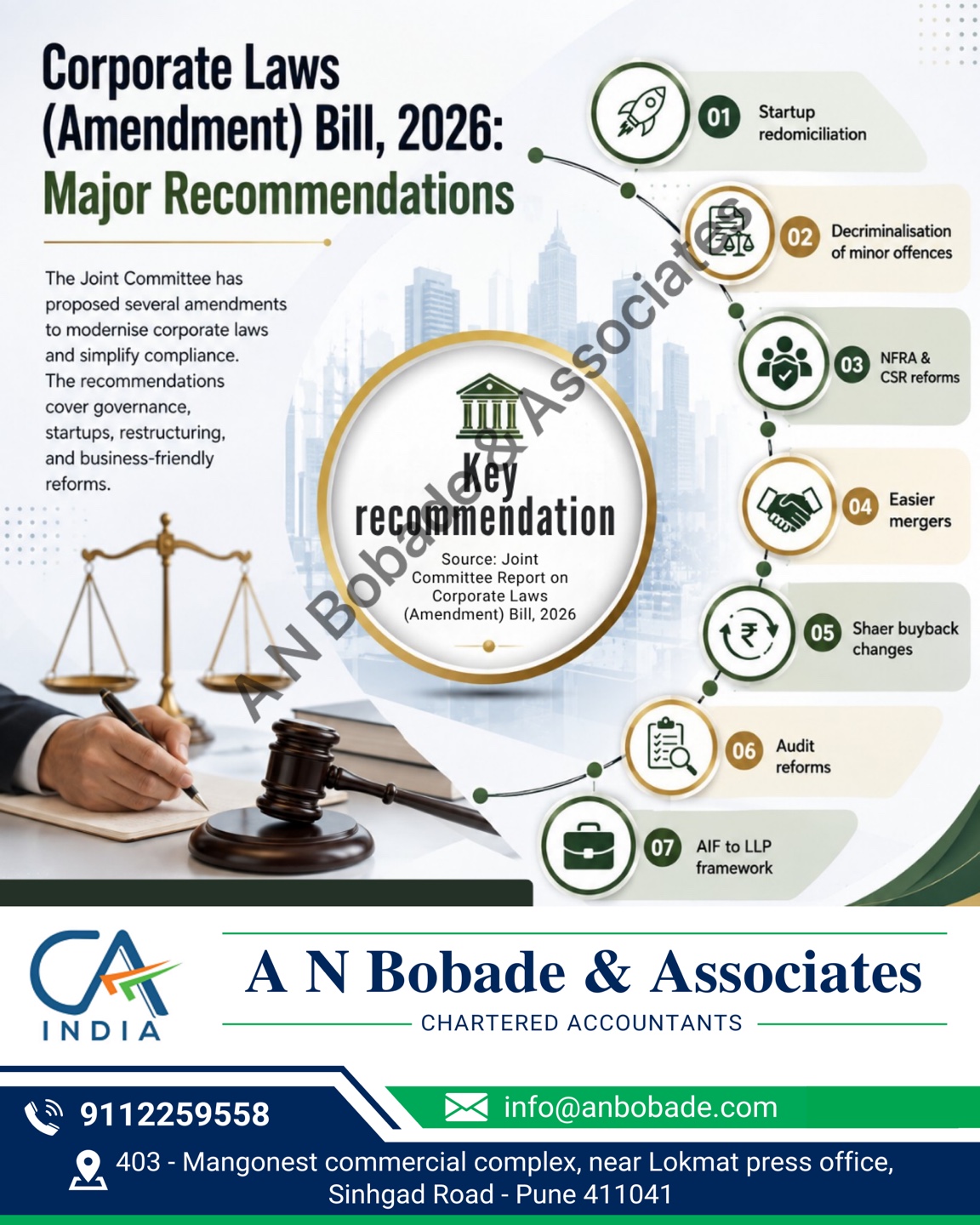
Corporate Laws (Amendment) Bill, 2026: Major Recommendations and What Businesses Need to Know
The Corporate Laws (Amendment) Bill, 2026 proposes significant changes to India’s corporate regulatory framework with the objective of simplifying compliance, improving the ease of doing business and modernising corporate governance.
The Bill was introduced in the Lok Sabha on 23 March 2026 and seeks to amend the Companies Act, 2013 and the Limited Liability Partnership Act, 2008. It has been referred to a Joint Parliamentary Committee (JPC) for detailed examination.
Importantly, these are proposed amendments and should not be treated as law until the legislative process is completed and the relevant provisions come into force.
1. Startup Redomiciliation
One of the important areas being considered is a framework that could facilitate overseas companies/startups shifting or “redomiciling” their corporate structure to India.
This could provide greater flexibility for businesses that have international structures but want to establish India as their principal corporate base.
The JPC has been examining this area as part of its broader review of the Bill.
2. Decriminalisation of Minor Corporate Offences
The Bill proposes to decriminalise several procedural and technical offences under the Companies Act and LLP Act.
Instead of criminal consequences, certain defaults may attract civil monetary penalties.
Examples include certain failures relating to:
- Furnishing information/documents to the Registrar
- Books of account requirements
- Compliance with certain rules
- Certain requisitions made by the Registrar
The objective is to distinguish genuine fraud or serious misconduct from routine procedural defaults.
3. CSR Reforms
The Bill proposes changes to the thresholds applicable to Corporate Social Responsibility (CSR).
Under the existing framework, CSR provisions generally apply where a company meets specified thresholds relating to net worth, turnover or net profit.
The proposed amendments include increasing certain thresholds, including the net-profit threshold from ₹5 crore to ₹10 crore, subject to the final legislative text.
This could reduce the number of companies falling within mandatory CSR compliance, while allowing the framework to focus on larger businesses.
4. Easier Mergers and Amalgamations
Another major proposal relates to fast-track mergers.
The Bill proposes to make certain mergers easier by modifying approval requirements. For specified categories, including certain small companies and holding company–wholly owned subsidiary structures, the shareholder and creditor approval thresholds are proposed to be reduced from 90% to 75%, subject to the applicable conditions.
This could make corporate restructuring faster and reduce procedural hurdles.
5. Changes in Share Buyback
The Bill proposes greater flexibility in share buybacks.
For prescribed classes of companies, the framework could permit buybacks more frequently, with the original proposal providing for up to two buybacks in a year with a minimum six-month gap.
For companies with strong cash flows and surplus funds, this could provide another mechanism for returning capital to shareholders.
6. Stronger NFRA Oversight
The Bill proposes to expand the powers of the National Financial Reporting Authority (NFRA).
The proposed framework seeks stronger regulatory oversight over accounting and auditing, including additional powers relating to investigations and professional misconduct.
What does this mean for companies and auditors?
Businesses may need to place greater emphasis on:
- Proper financial reporting
- Accounting standards
- Audit documentation
- Corporate governance
- Statutory compliance
- Timely response to regulatory requirements
7. AIF-to-LLP Framework
The proposed amendments also address the Alternative Investment Fund (AIF) and LLP framework.
The JPC is examining changes concerning the conversion/structuring of AIFs as LLPs, including the role of investors as partners in the proposed LLP structure.
This could provide greater flexibility for investment structures and clarify governance and liability arrangements.
What Does the Bill Mean for Businesses?
If enacted in its final form, the Corporate Laws (Amendment) Bill, 2026 could bring a significant shift towards:
Simpler Compliance + Faster Restructuring + Greater Business Flexibility + Stronger Regulatory Oversight
For companies, LLPs, startups, investors and professionals, the important areas to watch include ROC compliance, mergers, buybacks, CSR applicability, audit requirements, NFRA regulations and LLP restructuring.
Final Note
The Corporate Laws (Amendment) Bill, 2026 is still under parliamentary consideration. The JPC has been conducting clause-by-clause examination and has sought additional time to submit its report. Therefore, businesses should not assume that the proposed provisions are currently applicable.
The final provisions, rules and effective dates should be checked once the Bill is passed and the relevant notifications are issued.
For companies and LLPs, this is an important development to watch as India moves towards a more business-friendly and technology-driven corporate compliance framework.
Keywords: Corporate Laws Amendment Bill 2026, Companies Act 2013, LLP Act 2008, MCA Compliance, ROC Compliance, Corporate Law Reforms, CSR, NFRA, Share Buyback, Fast Track Merger, Startup Compliance, AIF LLP, Company Law India
Have Questions? We're Here to Help
Get expert advice from A N Bobade & Associates Chartered Accountants. Reach out to discuss your requirements.